
Political paraphrase of the eponymous essay written by Adolf Loos in 1908. The idea of communism placed in contrast with the idea of exterminating ornament.
The first version (white on white) presents mimicry, a refined way of being attached to the surface and ignoring propaganda.
It captivates through shallowness, the beginning of the perception of kitsch. In the second plan, the onion pattern becomes a kind of a commercial war paint.
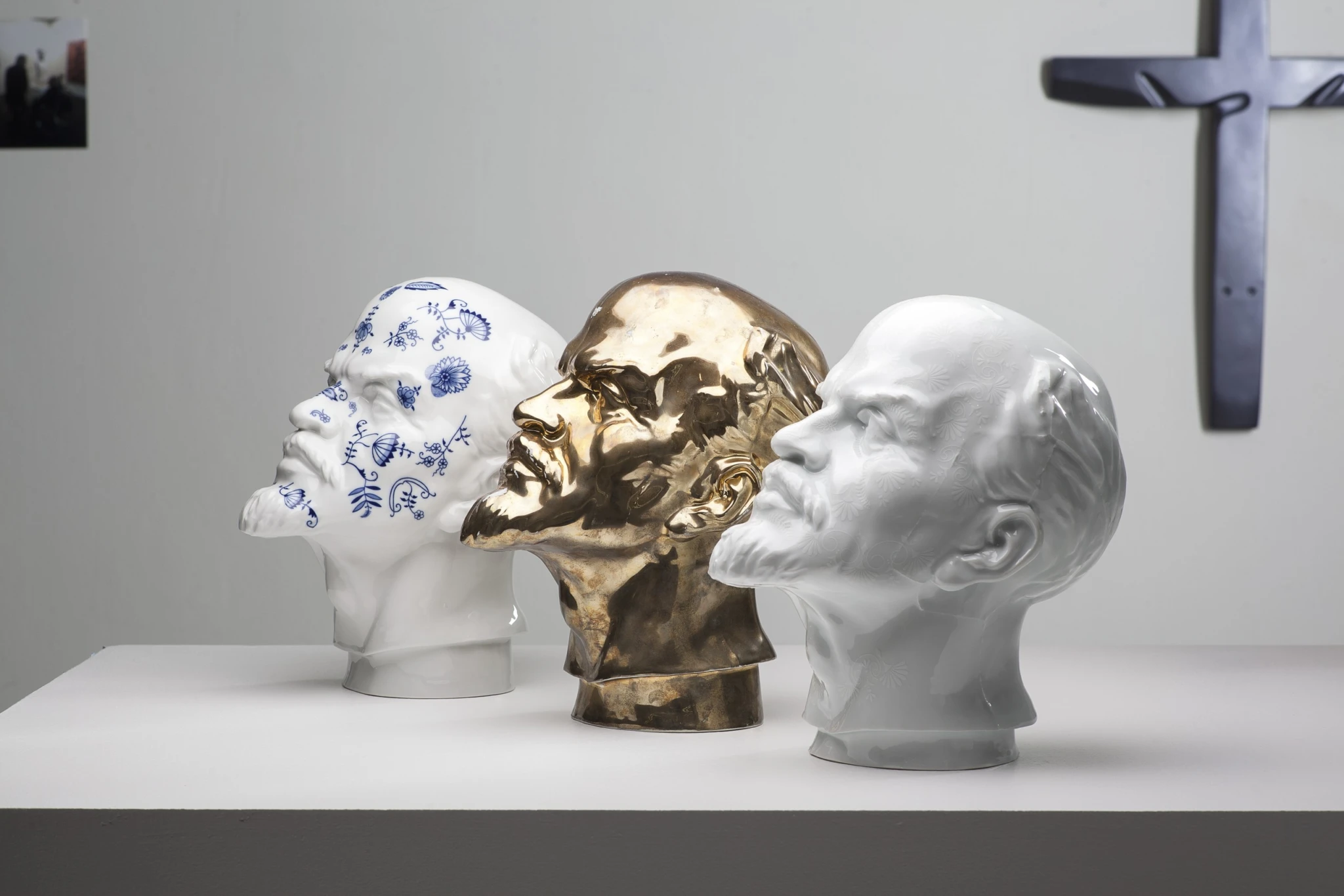
The heads of Lenin and Gottwald symbolize the Communist Party connections with Russia and the international dimension of the communist ideology. Porcelain is openly cast in the role of a favourite material of communist apparatchiks.
The onion pattern regularly employed by Maxim Velčovský, each time with a slightly different meaning, plays a key part here. For the artist it is a modern classic, a way of mediating dining on porcelain to the fast-food generation and a sarcastic memento of the bourgeois life style across history — but as it is in fact a “mutated” decoration originally of Chinese provenance, it is also a forgotten manifestation of globalization before globalization.